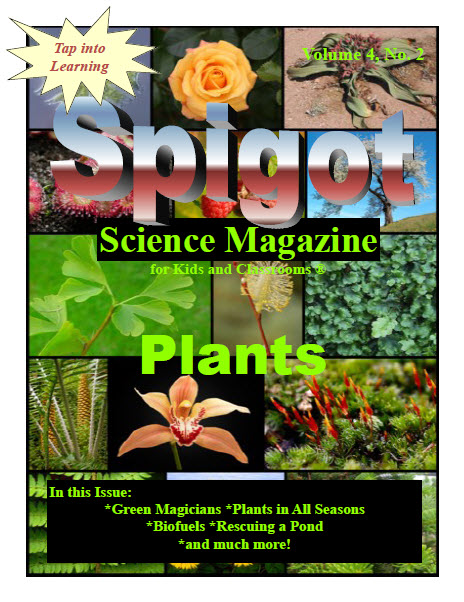
"Tap into Learning" Cross-promoting Spigot online.

Showing posts with label magazine for kids and teachers. Show all posts

Spigot Science in the News

  
Have you noticed that 2011 has had a lot of extreme weather? There has been record heat, drought, snow, tornadoes, and more. Our current release of Science in the News discusses these weather events and helps students understand the difference between weather and climate.
    
If you are a premium member, you can download the article and activities to share with your class right now!

If not, sign up today to get this and all the other publications.  There are now nine other Science in the News and 15 Spigot Science publications available for you to enrich your classroom instruction -- at a cost of less than 70 cents per publication!
    
Visit the Spigot Science site today to help your students understand many complexities and mysteries of the world we live in.

Teaching Science Vocabulary in Context

Science vocabulary can be difficult, sometimes even abstract, and this is one of the reasons students don’t connect when reading science texts or articles. If they don’t understand the vocabulary, then there is a very good chance that they won’t understand the underlying concepts.

Students need to see, hear, say, and write the vocabulary words in order to know them, remember them, and use them.  Seeing the definitions of science words in the context of the article helps students understand the meaning of the words and adds to the students’ understanding of the concepts. Here are some examples of “in context” definitions in the OCEANS publication: …more

David Cochran
Publisher, Chief Learning Officer
Spigot Science

Oceans Issue is Here!

They are wide and deep.  They are vast and have everything to do with life on Earth. 
    
 In this publication of Spigot Science, Oceans, we help students explore the mysteries of the deep from many perspectives.  In addition to learning the science of tides and ocean motion, they will learn all about what lives in the deep layers of the oceans and where all the oceans are located.
    
In the Language Arts Connection, students will write an ocean myth, and then rewrite a scientifically correct version.  In the Social Studies Connection, they will learn about the ocean census.  They will consider ocean safety in Health Connections, and in the Arts Connection, they will sing sea shanties and view ocean statuary.
    
Of course, our regular monthly feature segments focus on oceans too.  Students will learn to think deeply as they Think Like a Scientist and learn about the life of Jacques Cousteau in Scientists Are People Too.  In our Library Connection they will read ocean book reviews relevant to upper elementary and middle school students.
    
There is so much to learn about these waters that encompass 70 percent of our planet.
    
Premium members are entitled to all past, present, and future publications of Spigot Science for a whole year.  This includes all 15 of our themed publications as well as the monthly Science in the News.  Just log in to download Oceans.
    
If you are not yet a member, please visit us and sign up!   Tap into Learning with Spigot Science publications

Educating Gifted Children

by Linda Warren

Parents of gifted children sometimes find that it is difficult to give their children the education they need. Many people think that having a gifted child means that there are not problems in school for the student. This is far from the truth. In fact, gifted children have as many problems in school as those children of average educational aptitude, or even those children who have learning disabilities. It is just that the gifted children have different problems.

One problem that gifted children have is that they may not learn all subjects equally well. It is commonly thought that a gifted child can easily learn any subject that they are presented. And for some gifted children this is true. Because giftedness comes in many shapes and forms, some gifted children may find math to be a simple subject, easily learning new facts, and needing little repetition or reinforcement to be able to answer problems. That same gifted child might also voluntarily work more math problems that required, willingly exploring more math than is necessary to complete assignments. She might even explore math further, just because she considers it fun or entertaining. This gifted child might have trouble in other aspects of her education. For example, she might struggle with spelling, or other language arts.

The level of giftedness varies between children. Gifted does not mean that learning is effortless. Nor does it guarantee that there is not a cost somewhere else. Gifted children sometimes feel a great deal of pressure when parents or teachers expect them to do equally well in all subjects. Sometimes parents or teachers compound that pressure by telling the child something like, “You are so smart in science, you should be a doctor.” Just because a child may be gifted in science does not mean that being a doctor is what they are interested in. Yet if a child is told every week, from an early age, that they should be a doctor, because they are so gifted, then it becomes hard for them to break free of expectations.

In the classroom gifted children are sometimes given less attention rather than more. In part, this is due to the fact that children who learn easily are thought to not need specialized, or individualized instruction. Gifted students are often assigned as student helpers for children who do need more help. While this is great for the child who needs more help, it does not further the education of the gifted child. Giftedness is not just the ease of learning presented but also the need or drive to attain more information. If that hunger for knowledge is not fed in the gifted child then he may become bored, or even angered. This can lead to behavioral problems. The answer to solving the issues listed here regarding gifted children may not be as difficult as expected.


Gifted children tend to be creative and energetic. They are curious and questioning. It is possible to teach to those strengths, and their ability to learn easily and quickly, offering individualized instruction. This may be difficult to achieve in the typical classroom, there are ways to provide this. One alternative is smaller classes, where children can receive more individual attention. These smaller classes would also allow gifted children to explore their interests and delve deeper into subjects that they are good in, or have deeper understanding of. Another alternative to smaller class size is the home school environment, where the education of the gifted child can be completely individualized.

Gifted children can be challenging to educate, but they deserve as much attention as other students. In a time when it is not politically correct to celebrate exceptionalism, gifted students are sometimes not allowed to shine. They have needs, and weaknesses, and those need to be addressed when developing a curriculum. If we can provide these exceptional students with what they need today, society will reap the benefits of their creativity and ingenuity in the future.


About the Author:

Linda Warren is a writer. Her interests include self-sufficiency, and preparedness. She is a home schooling parent of one child for four years and counting with the online curriculum
http://time4learning.com/

Summer is for Collecting

Scientists are great collectors.  So much can be learned by gathering specimens, observing the similarities and differences and recording them in a journal.  Journals are great for illustrating and putting down when, where, why, and any interesting facts that tell the story.  And, summer is a great time to start collecting.  All the trees are full of green leaves, beaches are filled with seashells, and dirt is everywhere you might go.
 
Collect a leaf from trees in your yard, or park, or street.  Record in your journal and press them between the pages of a phone book or use a stack of old newspapers...read more 
 
Valeria B. Girandola
MSEd, Publisher, Editor in Chief
Spigot Science Magazine

Herbs - Plants for all Seasons

Herbs are wonderfully smelling, wonderfully tasting flowering plants that have been around since ancient times. They have many uses. Planted in the spring, parsley, sage, rosemary, and thyme are excellent for a kitchen garden.  They add flavors to everything from salads to desserts. Then there’s chamomile for tea as well as mint and lemon verbena.

For healing herbs, marjoram, mint, and oregano are said to help with digestion...read more 

Check out all of Spigot Science's back issues by clicking the specific picture below or visit; http://spigotsciencemag.com/