"Tap into Learning" Cross-promoting Spigot online.

Showing posts with label homeschoolers resources. Show all posts

Wind Turbines Convert Motion to Electricity - Technology Connection

Motion engineers are always on the lookout for new ways to capture natural sources of motion and convert then to electricity.  Wind turbines have been around for many years; some records show them being used by the Egyptians as early as 3000 BC.

Wind is made up of air, which is a gas. When air moves, it is called wind. Wind turbines work by placing propeller-like rotor blades on tall towers. As the air rushes by, its motion turns the blades. As they turn, the blade motion causes a rod called a shaft that is connected to an electric generator to turn. As electricity is generated, it goes into the electric grid and travels to wherever it is needed. This creation of electricity from moving air is an example of the transfer of energy from one source (moving air) to another (electricity).  READ MORE...

From Energy to Force to Motion - Science Connection

Tom looks at his pencil on the top of his desk. It does nothing. It is in a state of rest. He flicks it with his index finger and it rolls to a new place a few inches away. Tom may not realize it, but he is demonstrating one of the most important laws of motion. Objects which are at rest stay at rest until a force acts on them and causes them to move.

Motion Requires Force 

Motion does not happen unless there is a force acting on an object. Objects that are in a state of rest resist change. This resistance is called inertia. If there were no forces pushing or pulling objects, everything would be at rest all the time. There would be no movement! When energy creates a force to make an object move, it is call work. If an object is not moving, it is not doing work. But when the object moves, energy has caused its force to do work. READ MORE...

Motions Issue Now Available!

 Spigot Science has published its 16th publication. It is all about Motion, an important physics theme in upper elementary and middle schools. 

As with all its publications, Motion looks at the theme from an interdisciplinary viewpoint. Among the topics are Newton’s laws, gravity, motion in our bodies, math and motion, poetry in motion and more. There is a short play about Newton’s Law as well as quotes about motion.  


The issue is available for download today at the Spigot Science web site. If you are a Premium member you can download Motion as well as 15 other Spigot Science publications and 10 issues of Science in the News. Each membership includes the right to use downloaded materials with one teacher’s classes.

So check out our latest issue, and Tap Into Learning with Spigot Science.


Learning Math: Why Kids Get Frustrated and What Parents Can Do

by Maureen Stearns


When it comes to learning math, some students do just fine. Others, unfortunately, seem to hit all the snags and pitfalls while trying to learn.

Why is learning math frustrating for so many? Even those who are considered bright and hardworking have difficulty. Elementary school and high school require math and most college degrees require math too. College classes get bottlenecked with students who are taking the same math class for the second or third time. I've often heard, "I just have to pass this math class or I won't graduate!"

While teaching math to students, I have hypothesized why this occurs and it doesn't have anything to do with intelligence.

When learning math, a student must engage their full attention to the instruction. All it takes is for a student to daydream for a just few minutes and the whole week's key points can be lost to the learner. Not so with other subjects like reading and writing. A student can get away with occasional daydreaming in those subjects and still grasp the week's main point. Students can't get away with that in math. Having an absent mind for just a few minutes in math can produce poor results on tests. Making a dumb mistake on a test in reading does not produce an "F" like it does in math.

Learning math is a sequential process. Learners need to be firm with all the steps that lead up to the final answer and they need to be provided adequate time to process and practice just-taught information before a new concept is introduced. For some students, information presented in math books needs to be broken down into sub-steps that are not found in the textbooks--information that would need to be fine-tuned by the instructor. Unfortunately, because of classroom limits, there just isn't enough time to teach at every student's skill level or to break down math information for those who need it most.

A typical classroom of math students rarely starts on an even academic playing field. The differences and needs can be vast. Because of the abstract nature of mathematics, some students require multi-sensory techniques and extra drill and practice in order to catch on. There simply is not enough time to do this in most classes and if parents are unavailable or don't understand math themselves, the students suffer. It is hard for teachers to meet the needs of all math students, even with their earnest efforts and best intentions. Because of this, many math students never realize their full potential.

While working with students, I have found that the most glaring deficit in math understanding is a skill called "number sense" or the ability to have a feel for mathematical amounts. Students who have developed number sense do much better in math. Weak math students often produce answers that are not even close to being correct. They won't think to challenge whether their answer is logical--an indication they lack number sense.

Good news - even though academic frustration seems rampant, math frustration can be minimized with the help of adults playing math games or activities at home. Math games are fun and are motivating. They develop number sense and actually get kids to want to be involved. There are no class grades tied to the outcome. These activities do not need to be purchased and here's more good news--no tricky math understanding is needed for the adult. Any type of math game holds value and don't let the word "game" make you think that a math game is not academically worthy.

Here are some ideas. Some can be played alone.

  • Grab a handful of anything--jellybeans, marbles, paper clips, or pennies--anything that can produce "a bunch of." Have the child guess and write down the estimate, then count to confirm. Hands-on counting is a wonderful activity for students that need tactile validation.      
  • Find another handful of anything, estimate the amount, and then grab another handful of the same amount. Do the different handfuls hold the same amount?   
  • How many cereal Os does the child eat each morning?    
  • What is the value of a handful of pennies, nickels, dimes, or mixed coins? 
  • Fill three different sized cups with the same item. Estimate and write down how many is in one of them, count, then estimate how many are in the others. 
  • Look quickly in a drawer, close the drawer and then estimate how many items are in it.   
  • Estimate amounts in a see-through container. Guess the amount, write it on paper, count to confirm.
  • Estimate the weight of a backpack. 
  • How much time would it take to reach a certain destination?
  • Place three pennies on the counter. How many more are needed to make ten pennies? Repeat using different amounts that will equal ten. Put twelve cents on a counter. How much more will make fifty cents?
  • How long would it take to earn a certain amount of money?
  • How long would it take to earn $1,000 if you earned $5 a day walking the dog?  
  • How long would it take to spend a million dollars, spending a specific amount each day?  
  • How many inches would a 100-foot building be? 
  • Estimate weights of objects, then step on a scale. Fill a bag with items, or a suitcase, estimate the weight.  
  • Arrange objects heaviest to lightest. 
  • For older students, determine how many miles they can travel by car for 6 or 8 hours by traveling 55, then 65 miles per hour.   
  • Finally, discuss the child's strategies used for their estimating.
Increasing a students' number sense and math confidence will not solve all the challenges felt by both math strugglers and teachers. But developing number sense outside of school will certainly help. Students will be able to transfer their learned information into the classroom. Instead of just guessing the answer and hoping to be lucky, students will better know when their answer seems logical or have enough mathematical sense and confidence to keep on working.

About the Author;

Maureen Stearns--an author, parent, and educator living in St. Petersburg, Florida--has been teaching struggling learners for over 20 years. She holds both Exceptional Student Education and Community Psychology Degrees. She recently wrote Multiply and Divide with Sticks and Steps®: Teach this Easy Method in Just 5 Minutes, to help students conquer this stumbling block.

To learn more, visit http://www.sticksandsteps.com/ or http://www.ksblinks.com/.


GIVEAWAY
Leave a comment in this blog spot to be entered into my random draw for a copy of
 Sticks and Steps
closes Sunday January 22'nd.
Good Luck!

Geology of the Great Plains and Mountain West


Investigate how the earth was formed with 15 projects and fun facts in this new title by Nomad Press - Build it Yourself Series.

Here's a peek inside;

Introduction - Geology and Geography
Chapter 1 - Plate Tectonics Shape Our Land and Sea
Chapter 2 - Mountain Ranges
Chapter 3 - Volcanoes and Earhquakes!
Chapter 4 - The Plains
Chapter 5 - Climate
Chapter 6 - Rivers
Chapter 7 - Ecosystems
Chapter 8 - The Great Lakes

Geology of the Great Plains and Mountain West is an excellent, educational book.  And, as with all Nomad Press Build it Yourself books, Great Plains includes tonnes of informative facts and fun do-it-yourself projects. 

Check out, Make Your Own Popcorn Time p.g. 18, Make Your Own Needle-Like Crystals p.g. 58 and my personal favorite, Make Your Own Grassy "Tree" p.g. 96

Parents, you can't go wrong with this book!  It's packed with so many things to do and explore, your child will forget it's totally educational.

Nomad Press is on the web at; http://www.nomadpress.net/

Spigot Science in the News

  
Have you noticed that 2011 has had a lot of extreme weather? There has been record heat, drought, snow, tornadoes, and more. Our current release of Science in the News discusses these weather events and helps students understand the difference between weather and climate.
    
If you are a premium member, you can download the article and activities to share with your class right now!

If not, sign up today to get this and all the other publications.  There are now nine other Science in the News and 15 Spigot Science publications available for you to enrich your classroom instruction -- at a cost of less than 70 cents per publication!
    
Visit the Spigot Science site today to help your students understand many complexities and mysteries of the world we live in.

Science in School vs. Science in Life

Science is often taught as a separate subject in school. We treat it as something unique, discrete. But that is school, not life.
 
In life, we do not separate things into categories, because it is difficult to look at a real world event and decide which category it fits. For example, if we are studying the impact of drought on third world nations, are we studying science (lack of water), geography (global location of stricken nations), or social studies (how people with limited resources adapt).

The answer is often– it depends on which part of the problem we are studying. …more

by David Cochran
Publisher, Chief Learning Officer
      Spigot Science

HUGE HOLIDAY GIVEAWAY!

If you haven't discovered Nomad Press Explore Series AND you are still on the fence about Spigot Science then this is a great giveaway for you.  Check it out...

Nomad Press Simple Machines is a wonderful book that engages and teaches about how most machines are based on one (or several) of the very basics machines;
  • the Lever
  • Inclined Plane
  • Wheel and Axle
  • Screw
  • Wedge
  • Pulley
In addition, it includes some cool history facts, words to know and 25 great projects you can do with your child using everyday objects.  Check out Making Your Own Jumping Jack p.g 20, take the Chopstick Challenge p.g 24 or try your hand at Making Your Own Movable Pulley p.g 75.

The great thing about Nomad Press Explore series is your child doesn't have to be a science genius to have fun and learn about new and wonderful things.  Nomad Press is on the web at; http://nomadpress.net/

Nomad Press is awesome, but team them up with Spigot Science and it's unbelievable!

Spigot Science is published 4 times a year, taking one subject and delving into it.  Spigot offers fun articles, and games incorporating all aspects of teaching;
  • Science
  • Technology
  • Engineering
  • Math
  • Geography
  • Language Arts
  • Social Studies
  • Health
  • Arts
  • Library
Spigot Science is one of the most comprehensive and entertaining publications on the Internet today.  If you haven't checked them out yet (or if you're already a fan) we invite you to stop by Spigot Science at; http://spigotsciencemag.com/

Now that you know about these wonderful publications you can enter here to win a copy of Nomad Press Explore Simple Machines PLUS a Premium Membership to Spigot Science which includes all Spigot's back Issues as well as 4 brand new upcoming Issues. 

All you have to do is leave a comment is this blogspot letting me know you want to be entered (contact info too, please).  I will do a random draw on Sunday December 11th for one lucky winner.

Good Luck!

Take Five

by David Cochran

The first five minutes of class are critical to establishing a climate for learning.  Too often classes start with attendance and housekeeping chores rather than engaging students in thought related to the topic of the day.  Time is at a premium in most classes, so using that first five minutes wisely is important.

Here is what some teachers do to make the most of their start up time. …more

Explorers of the New World - A Review

I love Nomad Press! If you have yet to discover this publishing house, you are so missing out! They offer a wide range of books that not only educate, but entertain.

This brand new title, Explorers of the New World Discover the Golden Age of Exploration fits right in with Spigot's current issue, Oceans.

This book explores the men responsible for mapping out our world and includes:

~ Introduction - Exploring in the Age of Discovery
~ Searching for a Water Route to Asia
~ Voyage to the New World (Christopher Columbus)
~ Searching for a Northwest Passage (John Cabot)
~ Circling the Globe (Ferdinand Magellan)
~ The Spanish Conquistadors
~ Journeys Inland

In addition to all the cool history, Explorers offers 22 hands on experiments that can be done with household or easy to find items. Check out;

~ Make Your Own Cross Staff
~ Make Your Own Map Quest p.g 44
~ Make Your Own Ocean in a Bottle p.g 52
p.g. 18

I wish these books were around when I was growing up - they're awesome and make learning so much fun! This book is rated for the 9-12 crowd or children with reading level "S".


Check out, Explorers of the New World and other Nomad Press titles on the web at; http://www.nomadpress.net

Educating Gifted Children

by Linda Warren

Parents of gifted children sometimes find that it is difficult to give their children the education they need. Many people think that having a gifted child means that there are not problems in school for the student. This is far from the truth. In fact, gifted children have as many problems in school as those children of average educational aptitude, or even those children who have learning disabilities. It is just that the gifted children have different problems.

One problem that gifted children have is that they may not learn all subjects equally well. It is commonly thought that a gifted child can easily learn any subject that they are presented. And for some gifted children this is true. Because giftedness comes in many shapes and forms, some gifted children may find math to be a simple subject, easily learning new facts, and needing little repetition or reinforcement to be able to answer problems. That same gifted child might also voluntarily work more math problems that required, willingly exploring more math than is necessary to complete assignments. She might even explore math further, just because she considers it fun or entertaining. This gifted child might have trouble in other aspects of her education. For example, she might struggle with spelling, or other language arts.

The level of giftedness varies between children. Gifted does not mean that learning is effortless. Nor does it guarantee that there is not a cost somewhere else. Gifted children sometimes feel a great deal of pressure when parents or teachers expect them to do equally well in all subjects. Sometimes parents or teachers compound that pressure by telling the child something like, “You are so smart in science, you should be a doctor.” Just because a child may be gifted in science does not mean that being a doctor is what they are interested in. Yet if a child is told every week, from an early age, that they should be a doctor, because they are so gifted, then it becomes hard for them to break free of expectations.

In the classroom gifted children are sometimes given less attention rather than more. In part, this is due to the fact that children who learn easily are thought to not need specialized, or individualized instruction. Gifted students are often assigned as student helpers for children who do need more help. While this is great for the child who needs more help, it does not further the education of the gifted child. Giftedness is not just the ease of learning presented but also the need or drive to attain more information. If that hunger for knowledge is not fed in the gifted child then he may become bored, or even angered. This can lead to behavioral problems. The answer to solving the issues listed here regarding gifted children may not be as difficult as expected.


Gifted children tend to be creative and energetic. They are curious and questioning. It is possible to teach to those strengths, and their ability to learn easily and quickly, offering individualized instruction. This may be difficult to achieve in the typical classroom, there are ways to provide this. One alternative is smaller classes, where children can receive more individual attention. These smaller classes would also allow gifted children to explore their interests and delve deeper into subjects that they are good in, or have deeper understanding of. Another alternative to smaller class size is the home school environment, where the education of the gifted child can be completely individualized.

Gifted children can be challenging to educate, but they deserve as much attention as other students. In a time when it is not politically correct to celebrate exceptionalism, gifted students are sometimes not allowed to shine. They have needs, and weaknesses, and those need to be addressed when developing a curriculum. If we can provide these exceptional students with what they need today, society will reap the benefits of their creativity and ingenuity in the future.


About the Author:

Linda Warren is a writer. Her interests include self-sufficiency, and preparedness. She is a home schooling parent of one child for four years and counting with the online curriculum
http://time4learning.com/

The Sea Creatures We Love to Hate

They are slimy, giggly, and overall scary creatures. They often are greeted with terms of endearment like “yuck” or “disgusting”.  Nevertheless, kids can’t resist poking them with clam shells when they wash up on the beach.

Everybody seems to love hating jellyfish. Too many of them can ruin a perfectly enjoyable day at the beach. Sometimes they can actually sting you. Nobody is quite sure what purpose these creatures serve...more


David Cochran
Publisher, Chief Learning Officer
Spigot Science

Tour of a Leaf Factory

Science Connection - Spigot


When we look at a leaf fluttering in the breeze, it’s hard to imagine that there is a lot of activity going on inside it. A leaf is like a factory that converts the sun’s energy into read more... 

Herbs - Plants for all Seasons

Herbs are wonderfully smelling, wonderfully tasting flowering plants that have been around since ancient times. They have many uses. Planted in the spring, parsley, sage, rosemary, and thyme are excellent for a kitchen garden.  They add flavors to everything from salads to desserts. Then there’s chamomile for tea as well as mint and lemon verbena.

For healing herbs, marjoram, mint, and oregano are said to help with digestion...read more 

Check out all of Spigot Science's back issues by clicking the specific picture below or visit; http://spigotsciencemag.com/

Turning on the Spigot

What do two educators in the same writing group talk about? Think about? Write about?  Teaching, of course.  And that’s how Spigot Science Magazine for Kids and Classrooms came into being.

Drawing on our teaching experience, we decided there was a need for a specially focused classroom magazine that showed how science can be integrated in all school subjects.  It would be on one concept only, and could be used in all subject areas across the curriculum, like a mini-textbook. We designed our all-important TOC (Table of Contents) to be the backbone of our targeted articles, and also to ensure that we write for all the classes across the elementary and middle school curriculum.  Since science is all around us, we reasoned that science could and should be talked about in geography, math, language arts, social studies, health, and the arts. Our TOC is called Connections Across the Curriculum

Our Library Connection reviews illustrated books on each theme. These reviews describe the selections along with offering teaching ideas—a must for the language-rich classroom.

We checked out the Science Content Standards and, because of that, Think Like a Scientist, Scientists Are People Too, and the Health Connection became regular features.

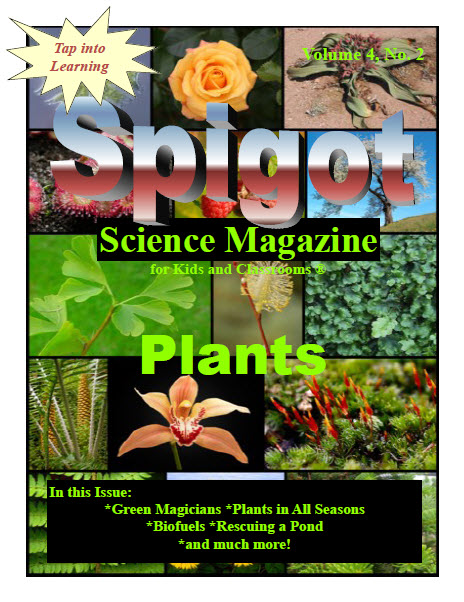
Our very first issue WATER, January 2008, started it off and an adventure was born. Since then we have created thirteen Spigots covering TREES, THE UNIVERSE, SIMPLE MACHINES, PATTERNS, ENERGY, ECOSYSTEMS, CHANGING EARTH, TELESCOPES, DESIGN, BUGS, ROCKS and MINERALS, SOUND and PLANTS (click below on magazine covers to check out these awesome back issues).

We started our fourth year of publication with our SOUND issue in January of 2011.  We are now introducing a monthly newsletter, Science in the News, and other activities to extend learning.

Our mission, “to help children understand how and why the world works…” translates into promoting reading, research, critical thinking and writing skills, along with science process and inquiry skills.  In other words, we are dedicated to the idea of science literacy for each child—thinking, analyzing, discussing, applying, and writing science—understanding that science is all around us, and appreciating that science truly does make the world go ‘round.


By; Valeria B. GirandolaMSEd, Publisher, Editor in Chief
Spigot Science Magazine